
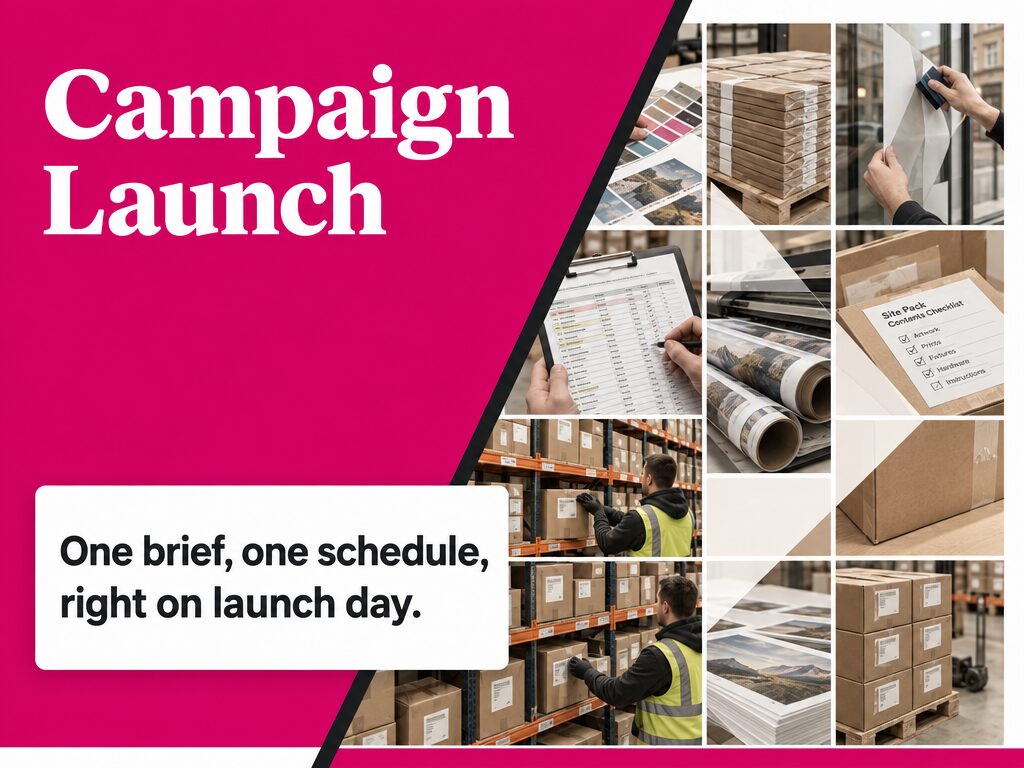
A flagship site opens on launch day with the wrong window graphic, because somebody printed version four of the artwork when version six was signed off. That single mix-up is usually the moment a marketing director realises print was never actually planned, just ordered. A campaign launch print plan is the process of planning, producing and delivering every printed item in a campaign through one brief, one schedule and one point of accountability. To plan it well, work backwards from the launch date rather than forwards from the creative sign-off. Lock the concept, build a single item list covering every format and every location, set an artwork deadline that leaves genuine time for proofing, specify substrates and print processes that hold colour consistently across the full range, then kit and deliver by site instead of by product. Build in a contingency stock of the items most likely to be damaged, lost or requested late. Done this way, launch week becomes a delivery confirmation exercise, not a rescue mission.
Who This Is For
This guide is written for Heads of Marketing and Brand Managers who own a campaign end to end and have a network of locations relying on them. You might be in retail, hospitality, financial services, healthcare or a franchise group, running anything from twelve sites to several hundred. Your campaign involves window graphics, posters, point of sale, leaflets, direct mail, exhibition panels and sales collateral, often produced by different suppliers on different timelines. You are judged on whether the brand looks the same everywhere on day one, and you rarely have a dedicated print or production person in the team to make that happen.
Launch Week Is Where Most Campaigns Unravel
The problem is almost never the creative. It is the fortnight before go live, when you are chasing five suppliers, three couriers and a print proof that has come back looking nothing like the brand red. Site managers ring to ask where their kit is. One region receives double the posters, another receives none. A retail brand we worked with on a 40-site rebrand rollout told us they had spent the previous launch fielding calls from branch managers asking where their window vinyls had gone, only to find two regional couriers had swapped consignments between sites. Marketing teams describe this to us as spending launch week as an unpaid logistics co-ordinator instead of measuring campaign performance. The cost is rarely the print budget. It is the discounting, delay and reputational wobble when a flagship site opens with the wrong window.
If your next campaign is already in the diary, now is the moment to map it. Book a campaign planning session with our team and we will build the item list, the schedule and the delivery plan with you.
What Good Campaign Launch Print Plan Actually Looks Like
Effective campaign print management replaces supplier juggling with a single production plan. Instead of you briefing a litho printer, a large format specialist, a mailing house and a fulfilment partner separately, one team takes the campaign brief and matches each item to the right process, the right material and the right lead time. Our production planners sit between the creative and the press, so artwork issues are flagged at pre-flight rather than discovered on a proof.
The difference shows in three places. Colour is managed across the whole range, not job by job, so a poster, a menu card and a vinyl decal look like the same brand. Delivery is organised by location, with each site receiving one labelled pack containing exactly what that site needs. And accountability sits in one place, so when something changes, and something always changes, there is one number to call. You can see how this works across formats on our campaign print management service page.
Consistent Brand Assets Across Substrates, Sites and Versions
Brand consistency breaks down at the material level long before it breaks down at the design level. The same CMYK build behaves differently on uncoated board, gloss vinyl and fabric, which is why a launch set produced by three suppliers rarely matches. Specifying substrates and colour targets at the planning stage, and proofing the range together rather than individually, removes most of that drift.
Version control is the second failure point. Regional price variations, opening dates and legal lines multiply artwork files quickly. Holding approved marketing campaign print materials in a managed brand portal, where local teams order from locked templates rather than emailing files around, keeps consistent brand assets consistent.
Step by Step: Planning a Product Launch Print Run
- Fix the launch date and work backwards. Set the delivery date two to three working days before go live, then map artwork deadlines, proofing windows and production time against it. This single reversal exposes unrealistic timelines while you can still fix them.
- Build one master item list. Record every format, dimension, quantity, substrate and destination in a single document, including items owned by other departments. Split quantities by site rather than by total, because totals hide the gaps.
- Site survey before you specify. Confirm window sizes, frame types and fixing methods at each location. Product launch print fails most often because a standard poster size does not fit a non-standard frame.
- Approve a range proof, not individual proofs. Review the full set together under consistent lighting so colour, tone and finish are judged as a family.
- Kit by location and label clearly. Each site receives one pack with a contents list, install instructions and a named recipient.
- Hold contingency stock and set a reorder route. Keep a percentage of high risk items in storage with a simple request process for replacements.
What to Watch Out For
- Sign-off drift. Artwork approval slipping by five days rarely moves the launch date, it just removes your proofing window and your ability to fix a colour issue.
- Averaged quantities. Sending every site the same pack means large stores run out while small ones store surplus in the back office for a year.
- Unspecified finishing. Lamination, folding, eyeleting and fixing method are often left off the brief and then rushed at extra cost.
- Ignoring installation. Somebody has to put it up. If that is store staff, the pack needs instructions and the right fixings included.
- Last minute courier bookings. Multi-site delivery on a fixed date needs planning, not a next day booking on the Friday.
Quick Checklist
- Launch date confirmed, with delivery scheduled at least two working days earlier
- One master item list covering every format, quantity and destination
- Site measurements and frame types verified, not assumed
- Substrates and colour targets specified before artwork is finalised
- A single range proof approved by the brand owner
- Packs kitted, labelled and addressed by site with a named recipient
- Contingency stock agreed and a reorder route communicated to sites
- A named contact for changes during launch week
How far in advance should I plan print for a campaign launch?
Allow six to eight weeks for a multi-site campaign with mixed formats, and ten to twelve weeks if it involves bespoke fabrication, fabric or overseas delivery. Straightforward reprints of existing artwork can run in two to three weeks. The variable is rarely production speed, it is how long artwork approval takes internally.
What is the difference between print management and using a printer?
A printer produces the items you specify. A print management partner specifies, sources, colour matches, kits, stores and delivers across multiple processes and suppliers, then reports on the whole campaign. If your campaign needs more than one production method, print management removes the co-ordination work from your team.
How do I stop print colours varying between different campaign items?
Specify a colour target at the planning stage, use the same production partner for the full range where possible, and approve a proof of all items together rather than one at a time. Different substrates will never match perfectly, so agree an acceptable tolerance up front with your brand owner.
Can I order extra campaign materials after launch?
Yes, if you plan for it. Holding contingency stock in managed storage and giving sites a simple ordering route means replacements ship in days rather than requiring a fresh print run. Without that, reprints usually cost more per unit and arrive after the moment has passed.
You already know whether your next campaign is properly planned or quietly heading for a launch week scramble. The difference between the two is usually decided now, weeks before artwork is signed off, when the item list, the site data and the delivery schedule are either built or left to chance. Every campaign has a point where adding structure stops being useful and starts being firefighting. If your launch date is set and the formats are still loose, you are on the right side of that line. Use the time.
Tell us what you are launching and when, and we will map the print plan around it. Get in touch with our campaign team to get started.